

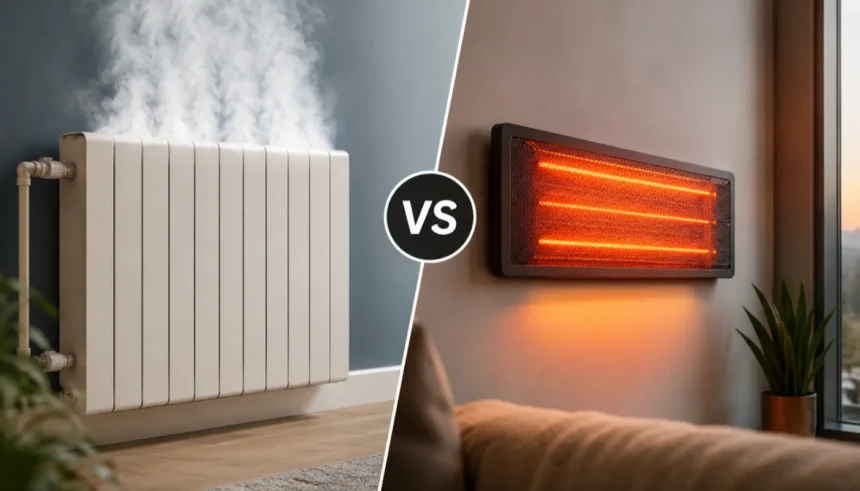
The word “efficiency” is very commonly used in the portable sauna industry. Marketing teams use it all the time to make saunas seem reliable and desirable. After all, if something is described as efficient, it means it does the job it was made to do. More importantly, it does that job well, whether steam vs infrared heating.
However, efficiency can mean many things. Is it efficient when it comes to electricity consumption or heat-up speed? Heat delivery or operating cost? Does it waste energy or does it use the energy effectively to achieve its purpose?
- How Steam and Infrared Heating Work
- What Is The Actual Power Consumption For Each Type?
- Heat-Up Time Comparison
- Energy Efficiency: Which One Has The Advantage?
- Which Heating Method Is More Efficient Overall?
- FAQ
- Do infrared saunas use more or less electricity than steam models?
- Steam vs infrared heating: Which one is faster?
- Which is cheaper, a steam or infrared portable sauna?
- How do infrared and steam saunas heat up the body?
- Conclusion
In truth, efficiency is a vague term that doesn’t answer any of these questions directly. But, as a potential portable sauna user, you likely still need answers to them. That is why this article will try to provide the answers instead.
How Steam and Infrared Heating Work
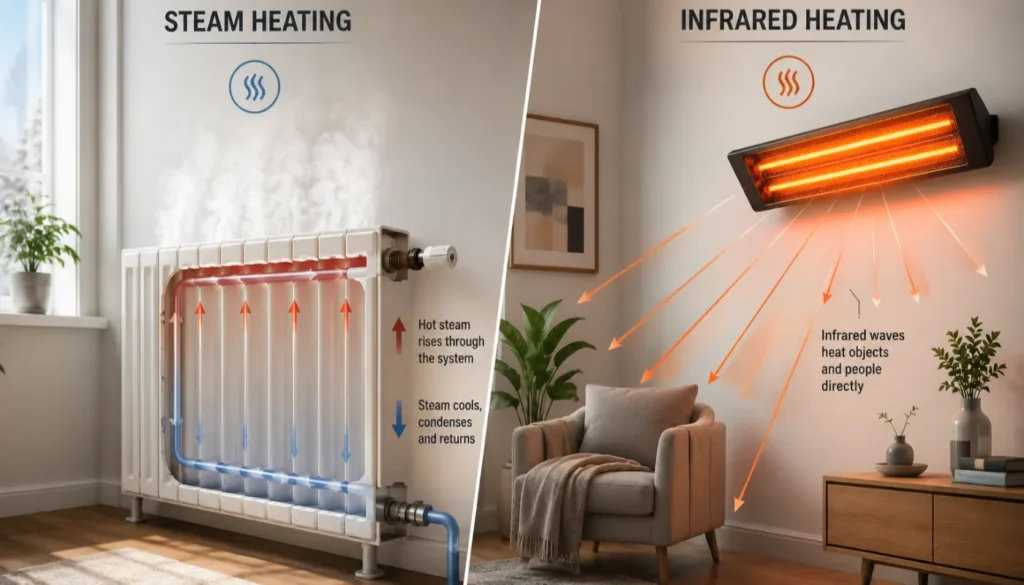
While steam and infrared saunas offer similar health benefits, they work quite differently. That is why it matters which one you choose.
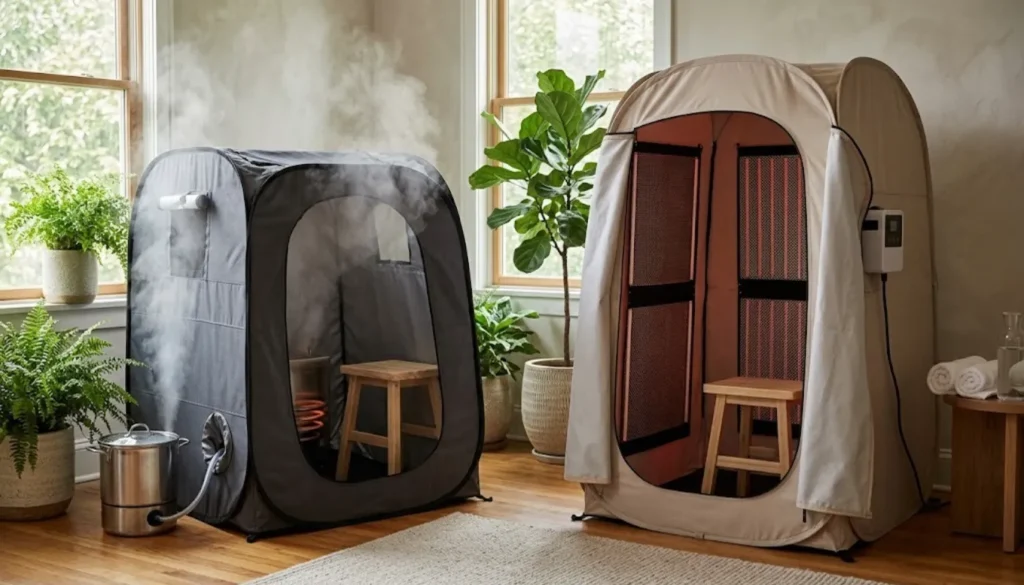
Steam heating uses an external steamer. This is a device that you fill with water, which then uses electricity to create steam. Electricity heats water, water becomes steam, and steam heats the air in the sauna tent.
As such, a portable steam sauna is the most similar to a traditional sauna. In terms of energy, however, most of it is used for heating water.
Infrared therapy works differently. Infrared tents come with infrared panels embedded into the fabric. Once you enter the tent, the infrared panels emit radiant heat. The heat targets the body directly, unlike steam units, which heat up the air inside the tent.
With infrared saunas, the heat is absorbed by the body directly, so there is no need to heat up the entire enclosure. However, this also makes for a very different experience. Infrared heat is dry and gentle, which is why infrared saunas don’t feel as hot as steam models.
With steam saunas, the humidity created by the vapor makes for a more intense experience. That is why steam saunas usually feel hotter, even if they aren’t when you measure the temperature.
What Is The Actual Power Consumption For Each Type?
Now that we know how each type of sauna works, let’s talk about the numbers. For a lot of people, efficiency means power consumption, so let’s see how each type does.
The first thing to note is that portable saunas typically do not require a lot of power. They consume about as much as most smaller household appliances. For example, a typical sauna session will consume about the same amount of power as a hair dryer.
With that said, there is a small difference between an infrared sauna vs a steam sauna.
A typical portable steam sauna experience will use 800W to 1500W. In comparison, a typical portable infrared sauna consumes 1000W to 1800W. Finally, a larger home infrared sauna will be the biggest spender. You can expect the largest models to consume around 1500W to 3000W.
With that said, wattage alone does not determine efficiency – at least, not completely. If a sauna that consumes 1500W runs for 30 minutes, it will use approximately 0.75 kWh. Note also that higher wattage systems can still be more efficient if they deliver heat faster or more directly.
Heat-Up Time Comparison
When using a portable sauna, you cannot just plug it in and hop inside right away. First, you have to wait for the system to heat up and get ready for use. The time needed for the sauna to get ready varies from model to model, but also between the types.
Generally, steam saunas are usually quicker to heat up and are often ready in 5-10 minutes. The exact heat-up time will be highlighted by the manufacturer for that specific model. In comparison, infrared saunas usually take a bit longer – between 10 and 20 minutes.
The reason is that steam rooms use water vapor, which fills up the tent fairly quickly. Humidity works fast, and the air gets ready within minutes for you to jump in.
Infrared saunas take a bit longer because heating panels are slightly slower. They need more time for gradual radiant heating to reach operational levels. With that said, fast heat-up time doesn’t automatically mean better efficiency. But, if you are in a hurry, the fact is that a steam sauna will get ready quicker.
Energy Efficiency: Which One Has The Advantage?

As explained previously, steam saunas work through water. They heat water, water becomes steam, steam fills the tent, and heats the user. Infrared saunas, on the other hand, heat the body directly.
While it may be surprising, less energy is spent heating the water. That also means that you need less power to heat the entire enclosure.
Furthermore, since steam makes the experience more intense, you also need to achieve lower temperatures. Finally, with steam in the tent, it is easier to reduce heat loss and maintain the temperature.
That also means that the steamer can stop working for a while, until the temperature drops again. Meanwhile, infrareds, which target the body directly, continue to produce heat the entire time.
Which Heating Method Is More Efficient Overall?

Keeping everything above in mind, you can understand why it is difficult to declare one sauna type as more efficient. Their approaches are too different to really compare.
For pure energy efficiency, infrared generally has the advantage. The reason is that it delivers heat more directly and doesn’t waste energy heating up the air.
However, steam is more efficient when it comes to warm-up speed. In terms of operating cost, the efficiency depends on wattage and session length. Because of this, you cannot say that one type is more efficient than the other. You have to compare actual, individual models.
Finally, you could also try to compare sauna efficiency in terms of comfort, but that is also highly subjective.
FAQ
Do infrared saunas use more or less electricity than steam models?
Infrared saunas typically use slightly more electricity than a steam sauna type. However, actual usage depends on session length and wattage type.
Steam vs infrared heating: Which one is faster?
Steam saunas generally tend to reach the recommended heat faster.
Which is cheaper, a steam or infrared portable sauna?
Both steam and infrared saunas are relatively inexpensive. With that said, infrared systems often have a slight efficacy advantage.
How do infrared and steam saunas heat up the body?
Steam saunas produce vapor that fills the tent. They first heat up the enclosure, which then heats the body. Infrared saunas use heating panels that target the body with infrared light directly.
Conclusion
Comparing steam vs infrared heating to determine the efficiency of portable saunas is complex. The actual results differ greatly because steam and infrared heating use different approaches. As such, you can’t point at one and declare it as more efficient than the other.
Instead, you need to compromise by picking a type and model that is more efficient at specific aspects of the sauna experience. For example, if the warm-up speed is important to you, steam saunas take the win.
Meanwhile, infrared generally transfers heat more directly. Wattage is also an important factor, but not the only one that matters.
Because of this, you cannot just look at the wattage between the two models and decide that the one with a bigger figure is more efficient. Other details and aspects matter too, so keep them in mind when picking a sauna.
With that said, if you need help picking the right model for you, check out our top picks for the best portable sauna for home.