

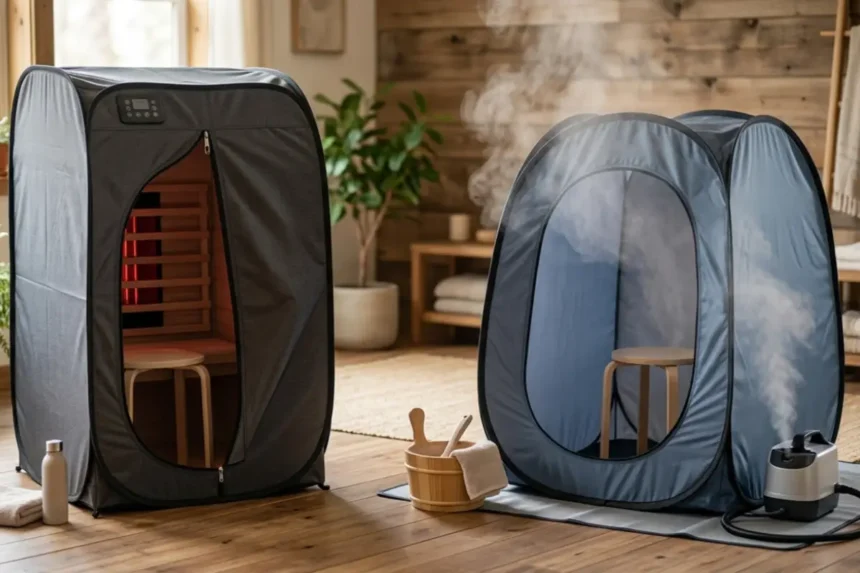
Portable saunas have developed a massive audience over the years. These days, they are becoming a very common home wellness tool. However, a lot of people still don’t seem to quite understand how does a portable sauna work.
A portable sauna’s purpose is to raise the user’s core body temperature. This triggers a response from the body where your heart starts beating faster, and you start to sweat. What matters is consistency, as regular use can result in many health benefits for the user.
- How Does a Portable Sauna Work in Detail
- Steam vs. Infrared: What’s the Real Difference?
- Which Heats the Body Better?
- Steam vs Infrared Sauna Benefits
- FAQ
- Is infrared better than steam?
- Do both make you sweat the same?
- Which burns more calories?
- Can beginners use both?
- Which Sauna To Choose – Steam or Infrared?
| A portable sauna works by generating heat inside an enclosed space (tent sauna). Doing so increases body temperature and induces sweating. Steam models use a generator that heats up water and turns it into hot vapor. Infrared models use light waves coming out of embedded heat panels to heat the body. The main difference is that the steam heats the air around the user, while infrared heats the body itself. |
When it comes to portable saunas, there are two main types – steam and infrared. They are not the same, and treating them like they are will result in the wrong buying decision. While the two types aim to achieve the same thing, the way they go about it is different.
How Does a Portable Sauna Work in Detail

Traditional saunas, such as the Finnish saunas, take up the whole room. In comparison, a portable sauna is just a tent (or an infrared sauna blanket) that you can fold and store away.
Beyond that, the basic principle behind portable sauna use is heat exposure. As you sit in the tent exposed to steam or infrared heat, your body temperature rises. This causes sweating, which is the result of a chain reaction. Your blood vessels expand, your heart starts beating faster, and your circulation increases. The experience is like a mild cardiovascular activity.
To achieve this, portable saunas need several components. The most important one is the heat source, which, as mentioned, can be a steam generator or infrared panels. A steam generator sits outside the tent and boils water to turn it into vapor that is then released into the tent. It produces a humid environment, with temperatures going to around 110-120°F.
Meanwhile, infrared saunas use infrared panels that emit IR radiation. Infrared technology produces dry heat, and it differs from the traditional sauna experience. They can reach temperatures of roughly 110-150°F.
Other than that, a portable home sauna also needs an enclosure, which is usually a tent or a blanket. Most portable sauna offers also include a chair or mat for your sauna box, and a controller that lets you set the temperature and timer.
Steam vs. Infrared: What’s the Real Difference?
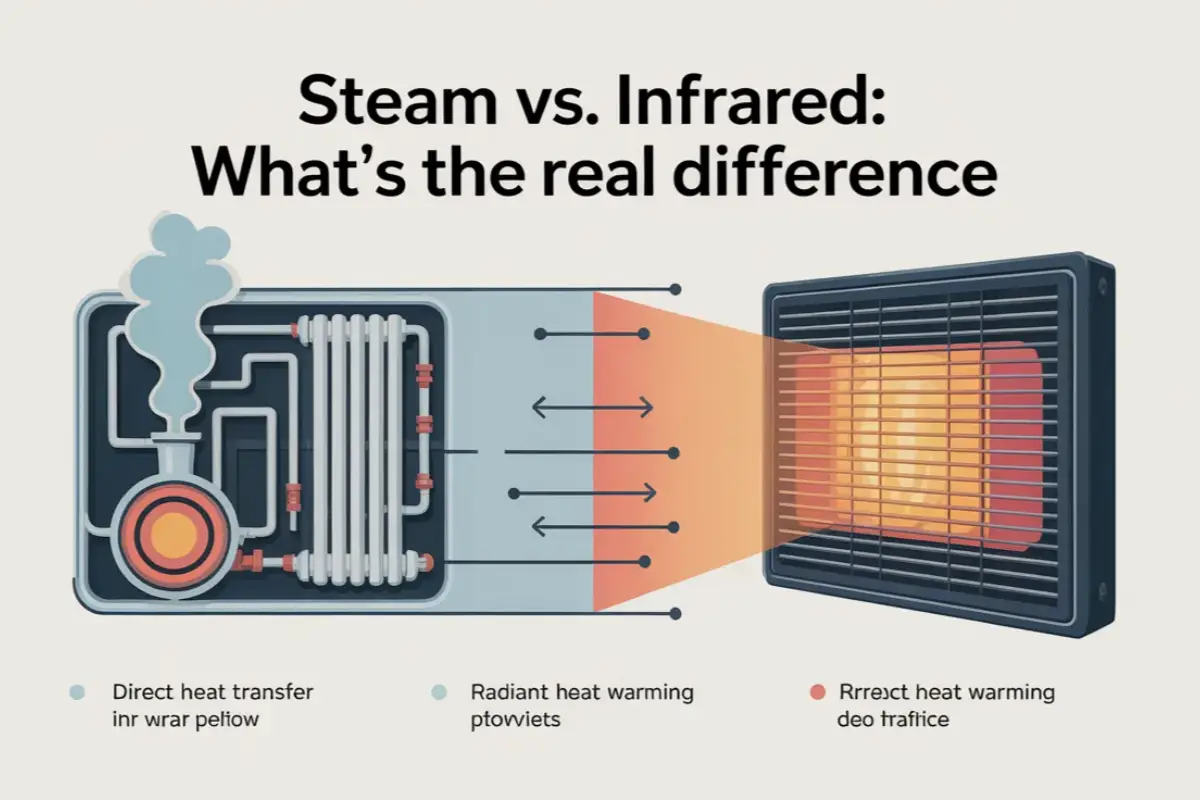
Now that you know how portable saunas work, let’s talk about the real difference between steam and infrared. As mentioned, a steam sauna uses heated water to produce steam and fill the tent. This creates a humid environment, heats the air, and then the body.
As a result, a portable steam sauna is great for skin hydration. It also provides the traditional sauna feel for those who want to enjoy it in the comfort of their own home.
Infrared sauna uses IR panels embedded into the walls of the tent or a blanket. The panels release IR waves that penetrate the skin directly, and they go deeper than steam heat.
This makes them a better choice for muscle recovery and easing joint pain. As a result, an IR sauna tent can come in handy after a workout or manual labor.
It is also worth noting that IR saunas produce dry heat. This warms the body without heating up the air around it. This type of heat is slower and more tolerable, making it better for longer sessions. It is also a good choice for beginners or those who struggle to breathe in humid environments.
| Feature | Steam Sauna | Infrared Sauna |
| Heat type | Moist heat (steam) | Dry heat (infrared radiation) |
| Temp range | 110-120°F | 110-150°F |
| Humidity | High | Low |
| Heating style | Air → Body | Direct body heating |
| Feel | Intense, humid | Gentle, dry |
| Setup time | 10-20min | 5-10min |
Which Heats the Body Better?
Most people pursuing heat therapy want to know which of the two is better for heating the body. However, the answer is not as straightforward as you might expect.
Infrared heat penetrates tissue slightly deeper, up to around 1.5 inches. This allows it to affect muscles and joints better than a steam sauna session.
But a steam sauna feels hotter because the humidity stops sweat from evaporating. Because of this, the steam sauna tent might feel stronger. As for the infrared dry sauna, it is slower, but it is also tolerable for longer.
Steam vs Infrared Sauna Benefits

Finally, let’s talk about the health benefits of sauna. No matter the type, you will experience some general benefits if you use them often. Relaxation, digital detoxification, improved sleep quality, and faster circulation are all common benefits.
As for type-specific benefits, a steam sauna opens pores and is good for skin hydration. It also loosens mucus, providing respiratory relief. In short, it can provide a similar experience to a traditional sauna.
Infrared models focus more on muscle relaxation and can provide joint stiffness relief. They are also better for those who struggle with high humidity, and make it easier to breathe.
One thing to note is that sauna reviews and ads often come with “detox” claims. However, such claims are largely overstated. Sauna does not do much to enable detox – that is the job of the kidneys and liver. Skin and sweating do not contribute in any notable amount.
FAQ
Is infrared better than steam?
That depends on your preference. If you prefer comfort over intensity, pick infrared. If you want a stronger experience, steam tents are the way to go.
Do both make you sweat the same?
Yes, but they use different mechanisms. You will still sweat, but your experience will be different depending on the type.
Which burns more calories?
Saunas often use calorie burning as a selling point but they don’t really contribute much in this regard. As for which one burns more – the difference is negligible.
Can beginners use both?
Yes, but infrared models are often easier to start with, especially if you have no prior experience.
Which Sauna To Choose – Steam or Infrared?
Deciding which is the best portable sauna is not easy, since the decision is based on preference. The main benefits of portable saunas are the same for both infrared and steam models. However, how they operate is different, as steam saunas heat up the air, while infrared ones heat the body. One produces a steamy, humid environment, while the other offers dry heat.
This is why it’s important to learn how does a portable sauna work, as knowing this helps you make the right choice. Both are valid options, but they work in different ways, so it is up to you to decide which is better for you.
If you need help with choosing a model, check out our best portable sauna for home use. Or, if you are on a budget, we also covered the best portable saunas under $200.